CONTINUED...
Second, the Lord's Supper illustrates for us the truth of our participation in the benefits of the death of Christ. Jesus told His disciples, "Take eat; this is My body. And when He had taken a cup and given thanks, He gave it to them, saying, "Drink from it, all of you" (Mt. 26:26¬27). Now, if the bread and the cup represent the body and blood of Christ given for us in His sacrificial death, then our taking and eating represents our appropriation of His sacrifice by faith. As we eat and drink, we are illustrating the truth that we must personally take in Christ and His work, making it ours by faith. As we eat and drink, in effect we are saying, "What He did, He did for me. I claim the benefits of the cross of Christ." Well, what are those benefits that come to us through the death of Christ? In
Matthew 26:28 we read, "for this is My blood of the covenant, which is poured out for many for forgiveness of sins." In
Luke 22:20 this covenant is referred to as the "New Covenant". There is a four-fold blessing to those who share in this New Covenant: 1) They shall have a new relationship to the law of God -- it will be written in their hearts. 2) They shall have a new relationship to the person of God -- He shall be their God and they shall be His people. 3) They shall have a new knowledge of God -- they shall all know God, from the least to the greatest of them. 4) They shall have a new standing before God -- they shall have all their sins forgiven. All of these blessings are received by those who enter into and receive the mercies of this New Covenant which was sealed in the blood of Christ at Calvary.
The Lord's Supper was instituted on the eve of Passover, and there is a very good reason for that. The Lord's Supper takes the place of the Passover for God's people. The Passover relates to the Old Covenant. It is a memorial of God's deliverance of all the firstborn Jews who had applied the blood of a lamb to the doorposts and lintel of their houses. In this way they were saved out of a cruel bondage to Pharaoh and his slavemasters in Egypt. Likewise, the Lord's Supper is a memorial of a deliverance as well. But the deliverance that Christ brings is far greater than the deliverance the children of Israel received. We are delivered from sin, Satan, death, and hell by Christ's shed blood. When we partake of the Lord's Supper we symbolize the fact that we appropriate these blessings by faith.
Thirdly, the Lord's Supper represents the spiritual nourishment of believers. Bread and juice are foods which nourish the body. They maintain our lives and give us strength. In the Lord's Supper we are reminded that Jesus Christ and Him crucified is that by which our souls are nourished and strengthened day by day. Christ Himself is the support and maintenance of our spiritual life. It was this truth that Jesus emphasized in
John 6:53-57 when He declared, "Truly, truly, I say to you, unless you eat the flesh of the Son of Man and drink His blood, you have no life in yourselves. He who eats My flesh and drinks My blood has eternal life, and I will raise him up on the last day. For My flesh is true food, and My blood is true drink. He who eats My flesh and drinks My blood abides in Me, and I in him. As the living Father sent Me, and I live because of the Father, so he who eats Me, he also shall live because of Me." Christ is pointing out here that His substitutionary atonement is the food our souls need to live day by day. Truly, the cross of Christ is God's refreshing, strengthening, and invigorating remedy for our spiritual lives!
Fourthly, the Lord's Supper represents the unity of all believers. We find this truth spelled out for us in
1 Corinthians 10:17 where Paul writes, "Since there is one bread, we who are many are one body; for we all partake of the one bread." Just as we only use one loaf when celebrating communion, even though that one loaf is divided into many pieces, so too there is only one body of Christ though it is made up of many members. The one loaf is intended to portray the truth that we are all one in Jesus Christ. One of the purposes of the Lord's Supper is to depict the unity that we possess in Christ. For this reason, it would be best to use a single loaf, instead of many different crackers, to depict this unity that we share in Jesus.
Fifthly, the Lord's Supper represents the future Messianic banquet we will enjoy when Christ returns. Notice carefully Jesus' words in
Matthew 26:29 directly after He had instituted the Supper, "But I say to you, I will not drink of this fruit of the vine from now on until that day when I drink it new with you in My Father's kingdom." Just as there is a backward look in the Lord's Supper to our Lord's death to inaugurate the New Covenant, so there is a forward look to that day when Christ will return and we shall sit down to sup with Him again in His Father's kingdom. This may have been what Jesus was speaking of in
Matthew 8:11 when He stated, "And I say to you, that many shall come from east and west, and recline at the table with Abraham, and Isaac, and Jacob, in the kingdom of heaven." Again, we have the Apostle Paul's words in
1 Corinthians 11:26 "For as often as you eat this bread and drink the cup, you proclaim the Lord's death until He comes." There is in the observance of the Lord's Supper an eager looking forward to that day when Jesus will return and we shall sit down with Him to sup in His Father's kingdom. That's why a thimble full of grape juice and a tiny cracker are not fit symbols to be employed. Only a full meal can adequately represent the Messianic banquet held out for our future enjoyment.
So, how did the Lord’s Supper become what it is today? First, the early Church Bishops of the Catholic Church demanded sole right to officiate the Lord’s Supper. They condemned private meals and the connection of the Lord’s Supper with them. This was supposedly to stamp out secret religious societies and heresy (early Oneness brethren). So the Lord’s Supper was separated from the meal. Then it was demanded that people attend the Mass wherein only a priest officiated the service. This required attending the Mass. Gathered in such large groups, the church had to offer more scant tokens of the Lord’s Body and Blood… so sacramental loafs and wafers were provided. Soon the terms “sacrifice” and “mystical” were attributed to the meal, as with earlier PAGAN meals. The doctrine of Transubstantiation was taught, teaching that the priest mystically called down the very essence of God and transformed the bread and the wine into the literal body and blood of Jesus. The meal was taking on every form of a pagan mystery rite. Special garb were assigned to wear during this period. The common Christian was eventually deemed unworthy to partake, and so for some time only the priests (who were deemed worthy) could participate; with the congregation merely acting as spectators praying that by some way special grace would be imparted to them too. And so… the Eucharist was born.
The Protestant Reformation brought back the idea that the Eucharist was memorial and not literal body and blood. The also began calling it “Communion” more than Eucharist. However, the meal remained CEREMONIAL in nature. This also translated into the Pentecostal churches where today it is regarded ceremonially with the tiny wafer and thimble of grape juice that is blessed and handed out by an acting religious official.
This is why I have begun to feel convicted that the manner in which most churches partake in the Lord’s Supper is unbiblical. We would do well to bring back the love feast of the Apostles. Of course, this requires smaller gatherings. And this too is strongly encouraged to fulfill all that Paul states the Lord “commands” in
I Corinthians 14, wherein all prophesy and the meeting is open and discussion based.
So, how should the Lord’s Supper be observed?
It Should Be Celebrated With Other Believers.
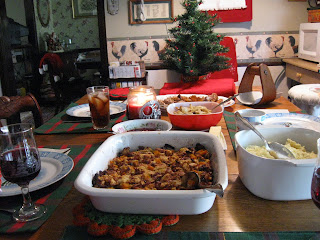
It Should Be Celebrated During A Common Meal Together.
It Should Be Celebrated With One Loaf And One Cup.
It Should Be Celebrated With The Blessing Of The Bread and the Cup.
It Should Be Celebrated By Breaking the Loaf in the Presence of the People.
It Should Be Celebrated With Believing Affection.
It Should Be Celebrated With Joy And Praise.
So, this New Years Eve… will you be found partaking in the Catholic Eucharist… or the Lord’s Supper?













 Linear Mode


